On Sunday, March 2, 2025, the U.S. Treasury Department announced that it would not enforce the Beneficial Ownership Information (BOI) reporting requirement for U.S. citizens and domestic companies.
Here are more details regarding the suspension of Beneficial Ownership Information (BOI) reporting enforcement by the U.S. Treasury Department:
- Background: The BOI reporting requirements were established under the Corporate Transparency Act (CTA) in 2021. The goal was to combat illicit finance and shell company formation by requiring businesses to disclose details about their beneficial owners to the Treasury’s Financial Crimes Enforcement Network (FinCEN).
- Suspension Announcement: On Sunday, the U.S. Treasury Department announced that it would not enforce penalties or fines associated with BOI reporting for U.S. citizens and domestic companies. This decision alleviated the regulatory burden on small businesses, which are considered the backbone of the American economy.
- Focus Shift: The enforcement efforts will now be directed exclusively at foreign companies. The Treasury Department will issue a proposed regulation to apply the BOI rule exclusively to foreign reporting companies.
- Penalties and Fines: Previously, businesses that failed to comply with BOI reporting requirements faced civil penalties of up to $591 per day (adjusted for inflation) or criminal fines of up to $10,000 and up to two years in prison.
- Legal Challenges: The enforcement of BOI reporting requirements had already faced multiple delays due to legal challenges. The preliminary injunctions against enforcement in these cases have been lifted.
- Statements: U.S. Secretary of the Treasury Scott Bessent called the decision “a victory for common sense” and emphasized that it is part of President Trump’s agenda to reduce burdensome regulations on small businesses2. President Trump also praised the move, describing the BOI rule as “outrageous and invasive” and “an absolute disaster” for small businesses.
LEARN MORE
The Michigan Earned Sick Time Act (ESTA) was set to take effect on February 21, 2025. The act requires employers to provide paid sick leave to their employees.
Here are some key points: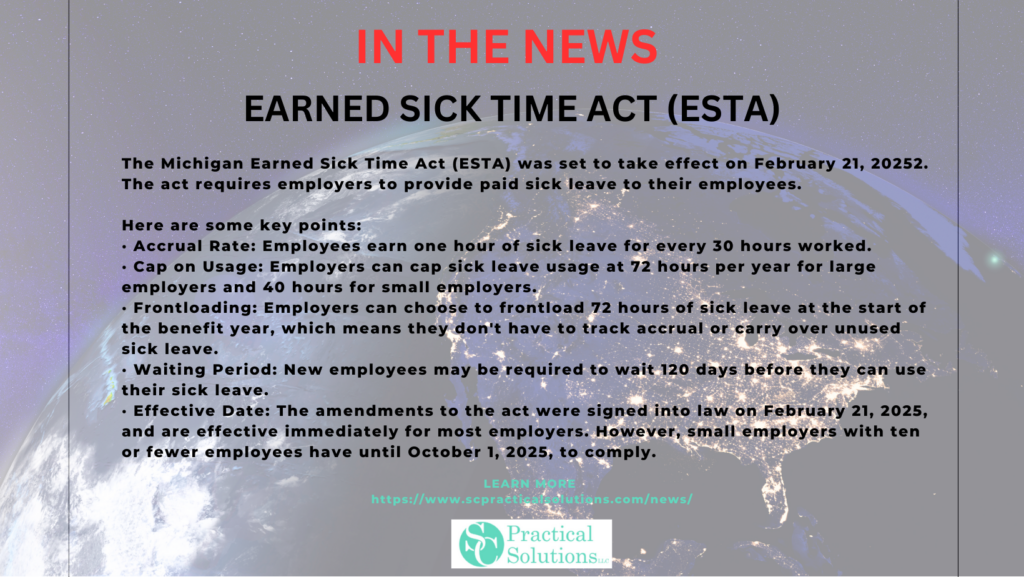
Accrual and Usage
- Accrual Rate: Employees accrue one hour of sick leave for every 30 hours worked. There is no cap on accrual, but employers can cap usage at 72 hours per year for large employers (over ten employees) and 40 hours per year for small employers (ten or fewer employees).
- Carryover: Employers may limit the amount of carryover to 72 hours for large employers and 40 hours for small employers.
- Frontloading: Employers can frontload 72 hours of sick leave at the start of the benefit year for large and 40 hours for small employers. If frontloading, employers are not required to carry over, track accrual, or pay out sick leave at the end of the year.
Waiting Period
- New Employees: Employers can require new employees to wait 120 days before using sick leave. However, accrual or frontloading is still required at the start of employment.
Combining with PTO
- PTO Policy: Sick leave can be combined with a Paid Time Off (PTO) policy, provided the PTO policy meets the ESTA requirements. PTO time can be used for sick leave purposes or any other purpose.
Rate of Pay
- Payment: Sick leave should be paid at the normal hourly wage or base rate, but not less than minimum wage. Overtime pay, holiday pay, bonuses, commissions, supplemental pay, piece-rate pay, tips, and gratuities are not included in the normal hourly wage/base rate.
Notice Requirements
- Foreseeable Leave: Employers may require seven days’ notice for foreseeable sick leave.
- Unforeseeable Leave: If the need for leave is unforeseeable, notice should be given as soon as practicable.
Exemptions
- Exempt Employees: Certain gig workers, unpaid interns, trainees, and minors are not eligible for earned sick time.
Compliance
- Small Employers: Small employers have until October 1, 2025, to comply with several ESTA requirements, including the accrual or frontloading paid earned sick time.
These amendments aim to provide greater clarity and flexibility for employees and employers, ensuring that employees have access to necessary sick leave while making it easier for employers to manage.
LEARN MORE
LEARN MORE
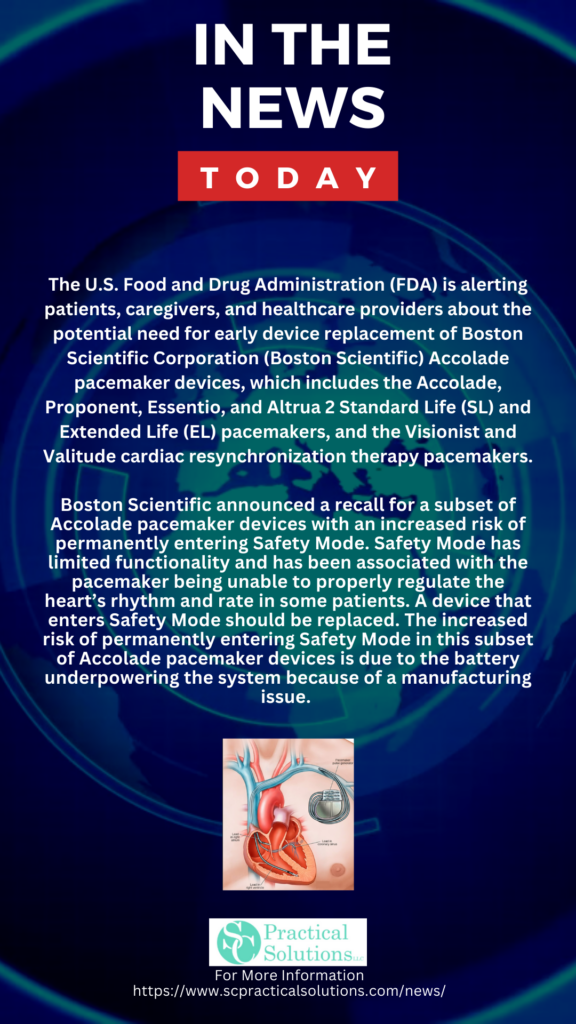
The U.S. Food and Drug Administration (FDA) is alerting patients, caregivers, and healthcare providers about the potential need for early replacement of certain Boston Scientific Accolade pacemaker devices. This includes the Accolade, Proponent, Essentio, and Altrua 2 Standard Life (SL) and Extended Life (EL) pacemakers, as well as the Visionist and Valitude cardiac resynchronization therapy pacemakers.
Boston Scientific has issued a recall for a specific group of Accolade pacemaker devices with an increased risk of permanently entering Safety Mode. In this mode, the pacemaker’s functionality is limited, which may cause it to fail in properly regulating the heart’s rhythm and rate in some patients. A pacemaker that enters Safety Mode should be replaced. The increased risk of entering Safety Mode is linked to a manufacturing defect that causes the battery to underpower the device.
LEARN MORE
 The Change Healthcare data breach, which occurred in February 2024, has had a lasting impact on the healthcare industry. Here are some key points about its effects one year later:
- Financial Strain: Many healthcare providers are still facing economic challenges due to stalled payments and other expenses. Some providers have taken loans to cover these costs and are still working to repay them.
- Operational Disruptions: While clinical disruptions have mostly subsided, some systems are still not fully operational. UnitedHealth is working to bring at least three platforms back online.
- Loss of Customers: Pharmacies like Fruth Pharmacy lost a significant number of customers who switched to other providers with more reliable systems. Fruth Pharmacy lost about 5,000 customers, which amounted to a loss of approximately 100,000 prescriptions over the past year.
- Increased Scrutiny: The breach has increased scrutiny and calls for improved cybersecurity within the healthcare industry. There is a greater emphasis on ensuring healthcare organizations adhere to cybersecurity standards and regulations.
- Data Breach Impact: The breach exposed data on 190 million consumers, making it the largest healthcare data breach reported to federal regulators. This has raised awareness about the importance of data security and the need for robust cybersecurity measures.
The healthcare industry continues to grapple with the aftermath of the breach, and it’s clear that the effects are far-reaching.
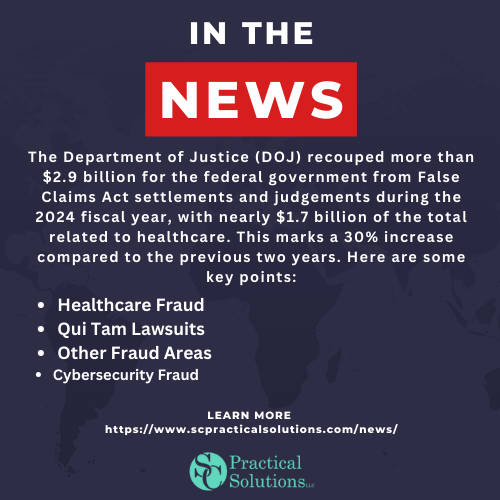 In fiscal year 2024, the U.S. Department of Justice (DOJ) announced that it recouped over $2.9 billion through settlements and judgments under the False Claims Act (FCA). This marks a 30% increase compared to the previous two years. Here are some key points:
- Healthcare Fraud: The majority of the recoveries, approximately $1.67 billion, were related to healthcare fraud, including issues like the opioid epidemic, unnecessary services, Medicare Advantage fraud, and unlawful kickbacks.
- Qui Tam Lawsuits: Whistleblowers filed a record-high 979 qui tam lawsuits, which is the highest number ever in a single year. These whistleblower actions accounted for over $2.4 billion of the total recoveries.
- Other Fraud Areas: Recoveries in non-healthcare and non-defense areas saw a significant increase, amounting to $1.15 billion, mainly driven by pandemic-related fraud.
- Cybersecurity Fraud: The DOJ also highlighted recoveries related to cybersecurity fraud, reflecting its ongoing focus on compliance with cybersecurity requirements in government contracts and grants.
Overall, the DOJ’s efforts in fiscal year 2024 demonstrate a strong commitment to combating fraud and protecting taxpayer funds.
LEARN MORE – DOJ
LEARN MORE