

Ransomware and hacking are the primary cyber-threats in health care. Over the past five years, there has been a 256% increase in large breaches reported to OCR involving hacking and a 264% increase in ransomware. In 2023, hacking accounted for 79% of the large breaches reported to OCR. The large breaches reported in 2023 affected over 134 million individuals, a 141% increase from 2022.
OCR recommends health care providers, health plans, clearinghouses, and business associates that are covered by HIPAA take the following best practices to mitigate or prevent cyber-threats:
The resolution agreement and corrective action plan may be found at: https://www.hhs.gov/hipaa/for-professionals/compliance-enforcement/agreements/green-ridge-behavioral-health-ra-cap/index.html
The HHS Breach Portal: Notice to the Secretary of HHS Breach of Unsecured Protected Health Information may be found at: https://ocrportal.hhs.gov/ocr/breach/breach_report.jsf
If you believe that your or another person’s health information privacy or civil rights have been violated, you can file a complaint with OCR at https://www.hhs.gov/ocr/complaints/index.html
HHS has developed guidance to help covered entities and business associates better understand and respond to the threat of ransomware. The fact sheet may be found here: https://www.hhs.gov/sites/default/files/RansomwareFactSheet.pdf?language=es – PDF
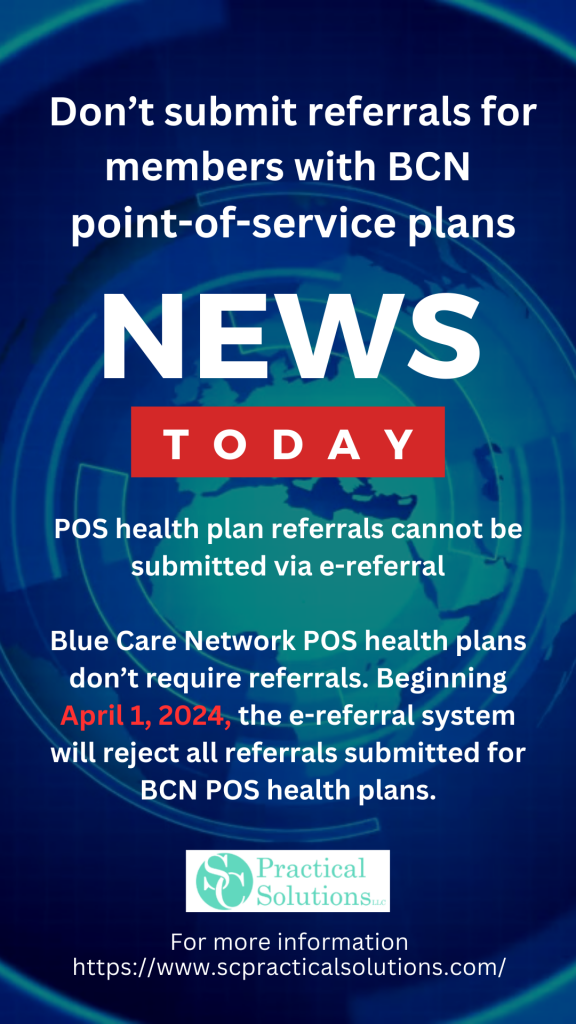
Don’t submit referrals for members with BCN point-of-service plans.
POS health plan referrals cannot be submitted via 3-referral
Blue Care Network POS health plans don’t require referrals. Beginning April 1, 2024, the e–referral system will reject all referrals submitted for BCN POS health plans.
Blue Care Network point-of-service health care plans allow members to receive covered services with any health care provider, in or out of network, with no referral required. Beginning in March 2024, the e-referral system will reject all referrals submitted for BCN POS health plans. How do you know which of your BCN patients don’t need a referral?
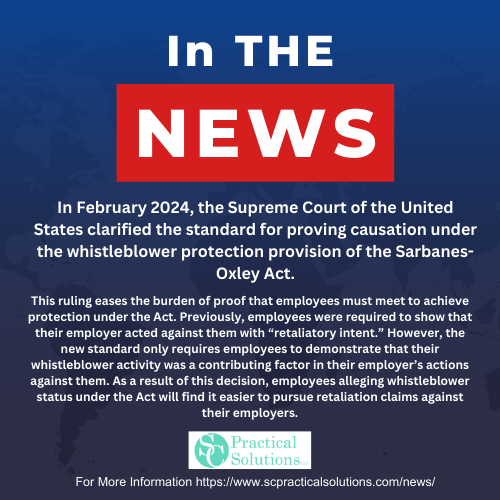
In February 2024, the Supreme Court of the United States clarified the standard for proving causation under the whistleblower protection provision of the Sarbanes-Oxley Act. This ruling eases the burden of proof that employees must meet to achieve protection under the Act. Previously, employees were required to show that their employer acted against them with “retaliatory intent.” However, the new standard only requires employees to demonstrate that their whistleblower activity was a contributing factor in their employer’s actions against them. As a result of this decision, employees alleging whistleblower status under the Act will find it easier to pursue retaliation claims against their employers1. Employers should exercise caution when taking adverse actions against employees engaged in activity protected by the law.
Additionally, leading whistleblower attorney Stephen M. Kohn outlines seven urgently needed reforms to U.S. whistleblower laws and policy2. Furthermore, companies subject to the Security Exchange Act should review their employment agreements, employee handbooks, separation agreements, and other confidentiality provisions to ensure compliance with Rule 21F-17(a), as there is little indication that the SEC intends to slow down its enforcement efforts in 20243.
LEARN MORE – WHAT WHISTLEBLOWERS WILL NEED FROM CONGRESS IN 2024
LEARN MORE – WHAT IS A WHISTLEBLOWER
LEARN MORE – US DEPARTMENT OF LABOR
LEARN MORE – WHISTLEBLOWER PROGRAM STATUTES AND RULES
 A federal judge has denied HCA Healthcare’s motion to dismiss antitrust litigation brought by North Carolina cities and counties related to the for-profit’s 2019 acquisition of Mission Health.
The ruling, signed Wednesday, February 21, 2024, relates to consolidated class-action complaints filed in 2022 by the city of Brevard, Buncombe County, the city of Asheville, and Madison County. HCA and Mission Health, both listed as defendants, filed motions to dismiss the complaint later that year.
LEARN MORE ANTITRUST LAWS – FTC
LEARN MORE ANTITRUST LAW
Final rule modernizes the health care system and reduces patient and provider burden by streamlining the prior authorization process
As part of the Biden-Harris Administration’s ongoing commitment to increasing health data exchange and strengthening access to care, the Centers for Medicare & Medicaid Services (CMS) finalized the CMS Interoperability and Prior Authorization Final Rule (CMS-0057-F) today. The rule sets requirements for Medicare Advantage (MA) organizations, Medicaid and the Children’s Health Insurance Program (CHIP) fee-for-service (FFS) programs, Medicaid managed care plans, CHIP managed care entities, and issuers of Qualified Health Plans (QHPs) offered on the Federally-Facilitated Exchanges (FFEs), (collectively “impacted payers”), to improve the electronic exchange of health information and prior authorization processes for medical items and services. Together, these policies will improve prior authorization processes and reduce burden on patients, providers, and payers, resulting in approximately $15 billion of estimated savings over ten years.