
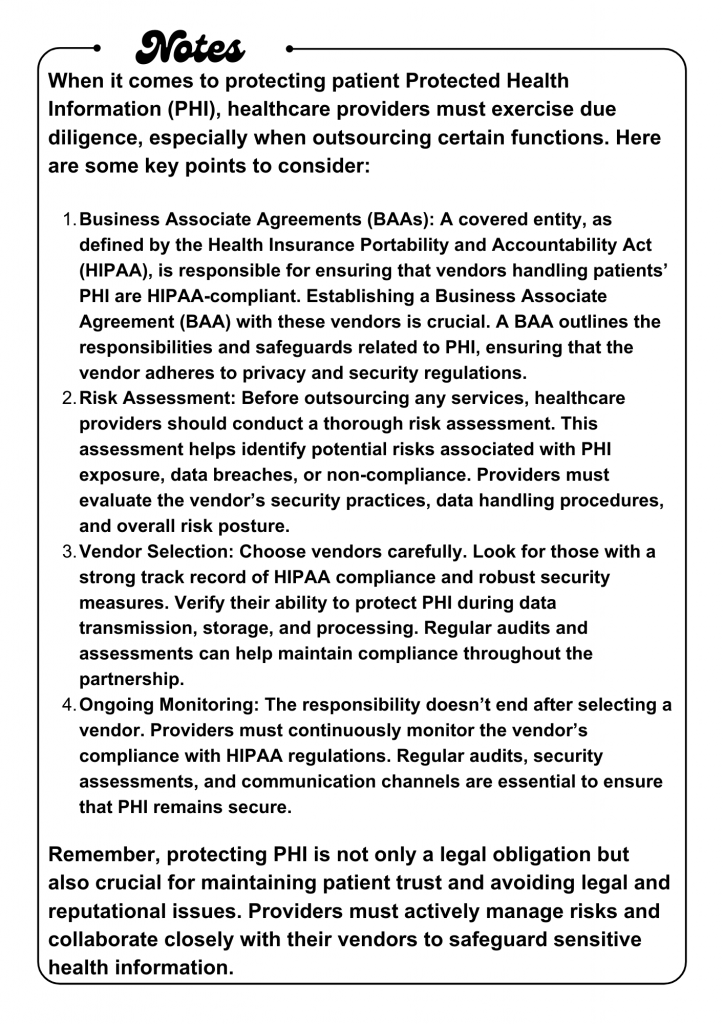

When it comes to protecting patient Protected Health Information (PHI), healthcare providers must exercise due diligence, especially when outsourcing certain functions.
The Centers for Medicare & Medicaid Services (CMS) requires that all providers, billing companies, and outsourced agencies use the Interactive Voice Response (IVR) system or your Medicare Administrative Contractor’s (MAC) eServices tool to verify Medicare eligibility and claim status. Increasingly, however, outsourced business associates are failing to adhere to this requirement.

On January 31, 2024, the Department of Health and Human Services (HHS) finalized rules for the prescribing of buprenorphine through the use of telehealth (rules first proposed in December 2022). In these final rules, opioid treatment programs (OTPs) will be able to use telehealth to prescribe buprenorphine without an in-person visit. It is important to note that these final rules are not in regard to using telehealth to prescribe a controlled substance in general. This is a very specific rule that applies to OTPs and the use of telehealth to prescribe buprenorphine with some additional applications specifically to methadone. The broader policy of using telehealth to prescribe controlled substances without an in-person visit (or meeting one of the narrow exceptions found in federal statute) still remains a temporary allowance through the end of 2024.
BACKGROUND
Readers may be aware that the COVID-19 public health emergency (PHE) activated one of the exceptions to using telehealth to prescribe a controlled substance without an in-person visit (or meeting one of the other narrow exceptions) which the Drug Enforcement Administration (DEA) oversaw during the pandemic. During the PHE, the Substance Abuse and Mental Health Services Administration (SAMHSA) also created a specific exemption for OTPs from having to conduct an in-person physical evaluation of patients who were being treated with buprenorphine if an OTP physician, primary care physician or authorized healthcare professional under the supervision of the program physician determined that such an evaluation could take place via audio-visual or audio-only telehealth. SAMHSA’s flexibility was extended for one year after the end of the PHE (to May 2024) or until a final rule is published. At this time, the waiver that the DEA oversees for prescribing of controlled substances has been extended to the end of 2024. This final rule only addresses the SAMHSA flexibility, as their regulatory authority in this area is limited to OTPs. SAMHSA developed the rule in consultation with the DEA and it addresses the use of telehealth for both buprenorphine and methadone use by an OTP.
LEARN MORE – US DEPARTMENT HEALTH & HUMAN SERVICES
LEARN MORE – FIERCE HEALTHCARE
Centers for Medicare & Medicaid Services (CMS) has released the CY 2024 Medicare Physician Fee Schedule (PFS) Final Rule, which includes policy changes for the Quality Payment Program (QPP) for the 2024 Performance Year (PY) and beyond.

On January 10, 2024, the U.S. Department of Labor published a final rule, effective March 11, 2024, revising the Department’s guidance on how to analyze who is an employee or independent contractor under the Fair Labor Standards Act (FLSA). This final rule rescinds the Independent Contractor Status Under the Fair Labor Standards Act rule (2021 IC Rule), that was published on January 7, 2021 and replaces it with an analysis for determining employee or independent contractor status that is more consistent with the FLSA as interpreted by longstanding judicial precedent.
The misclassification of employees as independent contractors may deny workers minimum wage, overtime pay, and other protections. This final rule will reduce the risk that employees are misclassified as independent contractors while providing a consistent approach for businesses that engage with individuals who are in business for themselves.
LEARN MORE – GUIDE TO NEW RULE
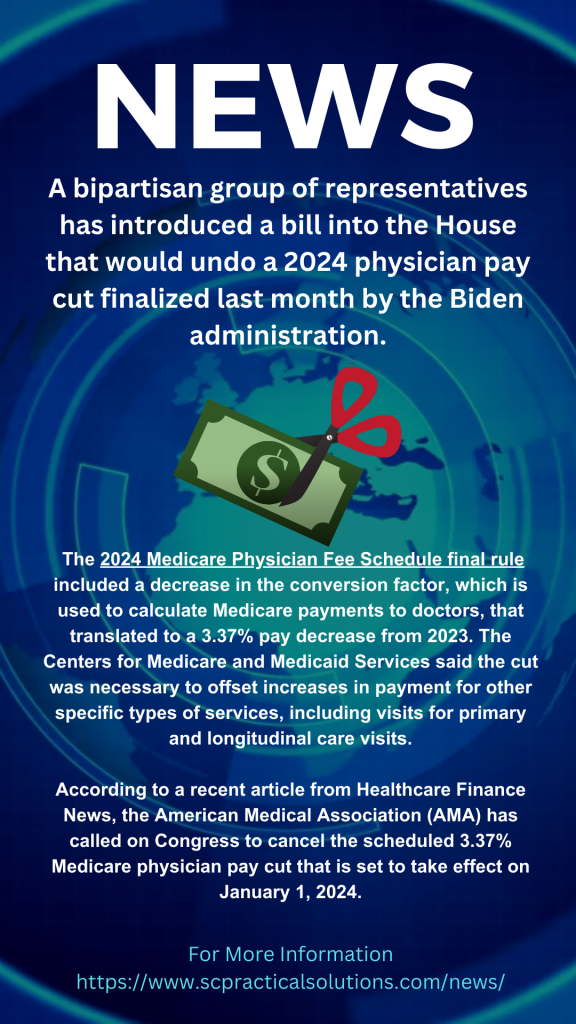
The 2024 Medicare Physician Fee Schedule final rule included a decrease in the conversion factor, which is used to calculate Medicare payments to doctors, which translated to a 3.37% pay decrease from 2023. The Centers for Medicare and Medicaid Services said the cut was necessary to offset increases in payment for other specific types of services, including visits for primary and longitudinal care visits.
According to a recent article from Healthcare Finance News, the American Medical Association (AMA) has called on Congress to cancel the scheduled 3.37% Medicare physician pay cut that is set to take effect on January 1, 2024. The AMA has expressed strong support for the Preserving Seniors’ Access to Physicians Act of 2023, a bipartisan bill that would completely eliminate the pay cut 1. The bill was referred to the Committee on Energy and Commerce and to the Committee on Ways and Means but did not pass before legislators recessed for 2023. However, the AMA has stated that Congress will consider a package of healthcare bills when it returns as part of a federal appropriations package in mid-January to fund the government in fiscal year 2024. A bill did pass the Senate Finance and the House Energy and Commerce Committees that would provide partial relief of 1.25% from the Medicare cuts
House bill introduced to cancel 2024’s physician pay cut
AMA’s New Year’s resolution for Congress: Cancel the Medicare pay cut | Healthcare Finance News